
The debut feature film by Mexican screenwriter and director Paulo Riqué, produced in partnership by Animal de Luz (Mexico) and Juntos (Chile), lands in Santiago to prepare for the final stage of principal photography.
The journey of 7 veces 7 (Seven Times Seven) formally began in 2004, when a young Paulo Riqué was scribbling the first lines of his script in the classrooms of Mexico’s Centro de Capacitación Cinematográfica (CCC). However, as a complex puzzle featuring inclement outdoor locations, animal handling, and the central figure of a resurrected dead man, the project remained financially unfeasible for nearly two decades.
It took the pandemic lockdown of 2020 for Riqué to tell himself: it’s now or never. The initial spark came thanks to the renowned Mexican producer Inna Payán (Animal de Luz), who connected emotionally with a story that, far from seeking immediate commercial profit, scrapes at universal human fibers. After recalibrating the compass of international financing, the Chilean production company JUNTOS entered the board, consolidating the co-production after winning local film funds in Chile.
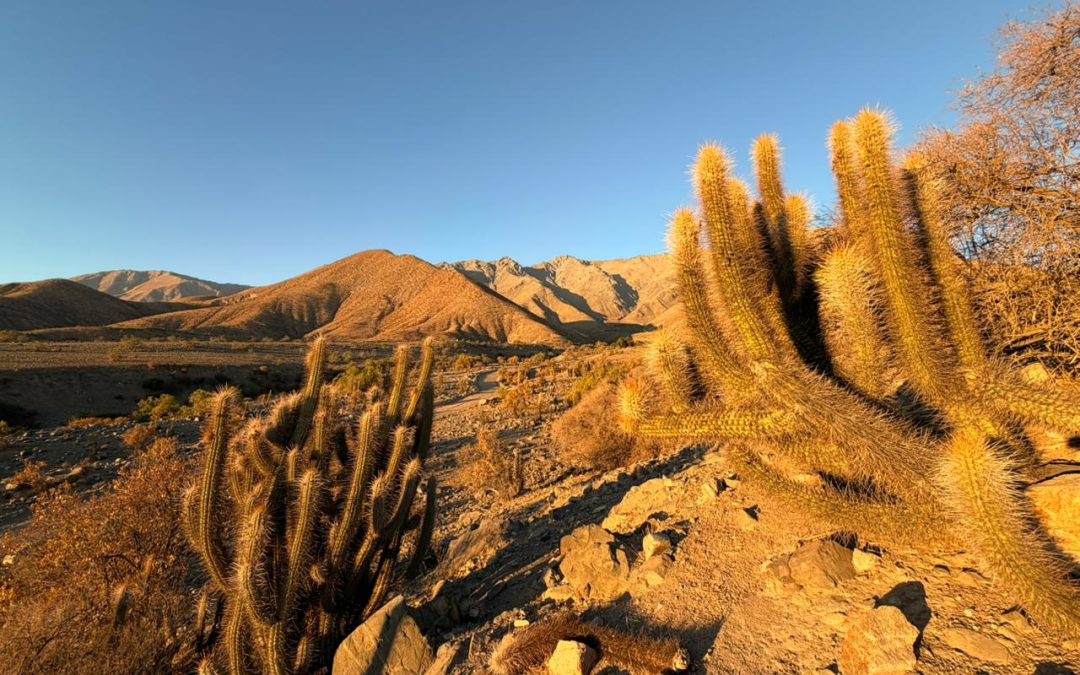
Today, after wrapping a grueling shooting block under the dry heat of Durango and the clamor of Mexico City, the team has landed in Santiago with a monumental challenge: filming in the mountains of the Elqui Valley and achieving seamless continuity between both hemispheres.
The Terror of Hatred and Internal Ghosts
The terror here is neither classic gore nor a cheap jump scare. Riqué clarifies that his heart beats closer to the mystical poetics of Andrei Tarkovsky, Wim Wenders, or Theo Angelopoulos. For the director, the film’s elevated horror is shaped instead by his childhood, Catholicism, syncretism, and his country’s own history.
The plot is an allegory of open wounds and contemporary dehumanization. It follows Conejo (José Salof), a mestizo man whose thirst for vengeance drives him to unearth and resurrect his father, Abraham Cruz (Arturo Reyes). To keep him alive, Conejo must continuously feed him through open wounds on his own arm. Amidst this feverish desert steps in Ramona (Paulina Treviño), the story’s moral counterweight and the embodiment of mercy in the face of a protagonist destroyed by his own hatred.
“We live in an era of terrible violence, hatred, and dehumanization, and for me, it is important to take it to the other side… to propose that the path must be a more loving one,” Paulo Riqué explains.
The Poetic Eye and On-Set Intuition
True to his instinct, Riqué bypassed casts assembled by algorithms or Instagram follower counts, recruiting a cast with pure theater pedigree. The chemistry with his actors has been so symbiotic that Paulina Treviño herself ended up becoming a co-creator of the film: a crucial scene in the script was literally born from an actual dream the actress had about her character, which she sent to the director via a voice note.
That same intuitive drive guided the selection of Chilean cinematographer Diego Pequeño. Setting aside bigger market names with longer trajectories, Riqué was captivated by Pequeño’s “poetic eye” after seeing his work on the feature documentary Cobija. During location scouting across Mexico, music and imagery became a shared language through which they understood each other almost without speaking.
A Logistical Puzzle
While the first segment in Mexico resolved the story’s more social and dialogue-driven conflicts, the shooting days in Chile will function as the piece’s spiritual and introspective journey.
“We will be filming in the mountains of the Elqui Valley. We have to set up a base camp because there is absolutely nothing out there; we have to bring everything in,” warns Felipe Egaña, producer and partner at JUNTOS.
The Chilean crew will lead a large-scale deployment outside the Santiago Metropolitan Region, reactivating complex logistical systems previously tested on Oro Amargo, which was shot in the heart of the Atacama Desert. This includes practical effects, artificial rain, gunfire, animal handling, and building an underground chamber to protect the actors.
The true puzzle, however, lies in continuity. Having shot the first block in Mexico, JUNTOS has had to import wardrobe and props—including identical prosthetic makeup—while simultaneously building an exact replica of a pickup truck with all its specific quirks. The vehicle has spent a month in a Chilean workshop being modified before heading out to the set.
For Paulo Riqué, moving from the deafening noise of Mexico City to the “overwhelming spirituality” of the Chilean mountains is the fulfillment of a dream more than twenty years in the making. In the very land that fueled Gabriela Mistral’s poetry, the cinematography of JUNTOS and Animal de Luz sets out to capture one of the boldest, most beautiful, and poetic genre bets in contemporary Latin American cinema.