
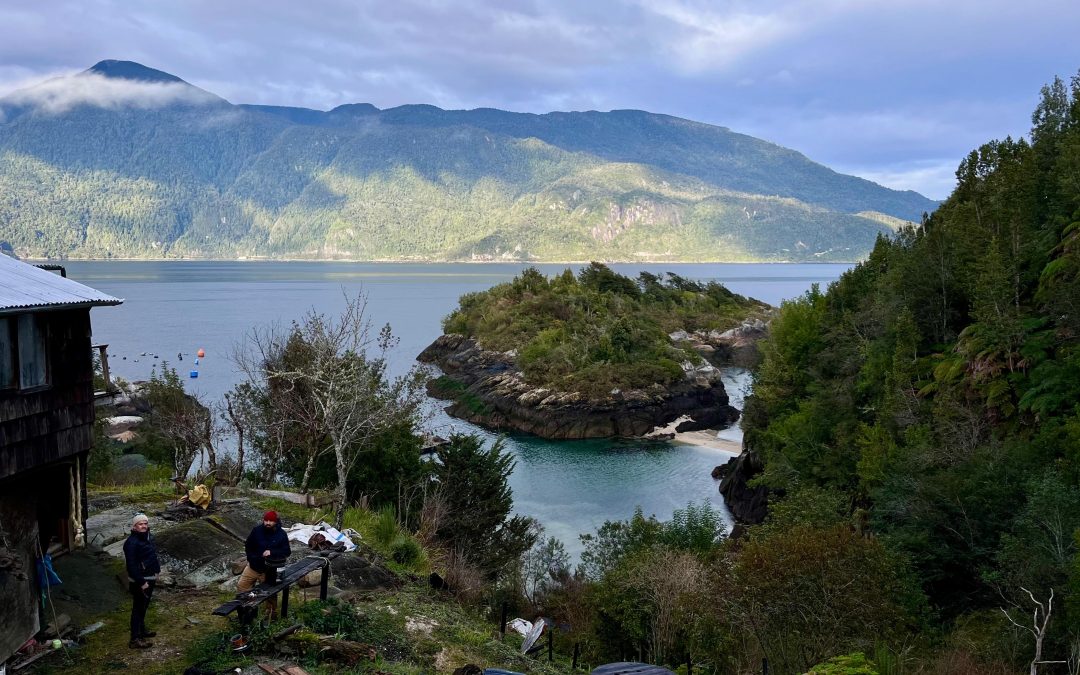
This week, director Francisco Bermejo set course for the south to begin filming a movie that challenges the very nature of imagery: a journey following a man who sees through his fingers and a mythology that refuses to be captured.
There are places that can only be reached if the sea permits, and Barquitas, in Chiloé, is one of them. This is where the latest JUNTOS venture lands: a project that has mutated over seven years to become La Velera (or Truquilawén). Francisco Bermejo, director of El Otro, reunites with JUNTOS to immerse himself in a story where auteur cinema and genre film merge beneath the mist.
At the heart of this story is Lalo. A carpenter and craftsman who is blind, Lalo builds scale-model boats and reforests his woodland with a precision that defies logic. “He touches everything and perceives the world in his own way; I say he has eyes in his fingers,” Bermejo explains. This film goes beyond a conventional biographical portrait; it is an immersion into the layers of a territory where sorcerers are not legends from a book, but neighbors who hide their tools.
The film delves into this extraordinary everyday life to explore the tension between material reality and the invisible, where mythology and witchcraft are forces that coexist with the landscape, rather than being mere folklore. It is, in essence, an attempt to bring to the screen what resists the image: the gaze of one who cannot see and the mysterious pulse of a territory like Chiloé.
This film is part of a broader interest within JUNTOS to explore new ways of storytelling. “We are looking for auteur films that dialogue with commercial genres. Viajero Inmóvil was a zombie documentary; Una Señora Invisible was horror. And now, with La Velera, fantasy appears. It is a search, using cinematic ingenuity to stage something that cannot be achieved simply by turning on the camera,” explains Pancho Hervé, the film’s producer.
The shoot will be executed in four acts. This exercise involves the team returning to the editing room after each journey to let the material, and Lalo himself, dictate the next step. While you read this note, in some corner of the Chiloé forest, the camera is already rolling. As the director puts it: “It is an exercise that is inside and outside of cinema at the same time. The thesis of this work is to film what refuses to be filmed”.