
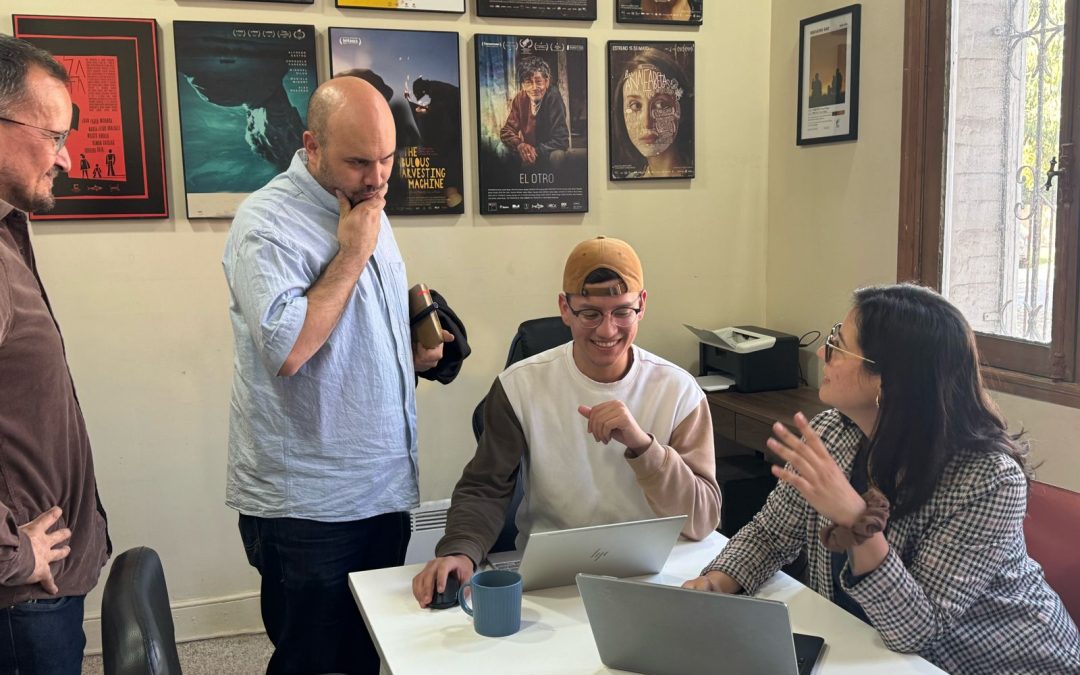
He left behind Hollywood’s romanticized vision to understand cinema as a political tool. During his time at JUNTOS as an executive production assistant, Juan Camilo Molina (JC) proved that in this industry, maturity is not a matter of age.
There is a common idea that internships are for watching from the sidelines or serving coffee. That is not the case for Juan Camilo Molina at JUNTOS; he arrived just in time to face the intensity of March: the CNTV and Ibermedia fund applications.
Raised in Chile after migrating from Colombia at age 11, JC views art as a space for visibility: “I would like cinema to truly be the spokesperson for those voices that are silenced in the world; to see it as an act of resistance,” he comments on the eve of graduating as an audiovisual director.
For Pancho Hervé, founding partner of JUNTOS, JC’s presence was a surprise in terms of maturity. “I was surprised by how capable he is despite his limited experience. He has a very strong ability to communicate and understand the necessary steps to complete large-scale applications,” says Hervé. It is uncommon for an intern to manage communication between teams in Chile and Argentina for international funds, but JC took on tasks usually reserved for senior profiles.
That level of responsibility allowed him to grasp one of the industry’s harshest lessons: “Paper can hold anything, but often Excel doesn’t withstand what’s tangible. You can plan a lot in pre-production, but what actually takes place isn’t what you planned,” JC reflects. He honed this adaptability in the field, filming his thesis project in Chiloé with Amparo Noguera, in a territory he describes as “beautiful but hostile.”
In an industry that sometimes feels closed off, JC values the horizontal hierarchy he found while working directly with Karla Falcón and the partners. “It was incredibly educational to be in work meetings where projects were discussed horizontally. I felt my voice was heard,” he states.
“At JUNTOS, we believe that internships are learning opportunities for both sides,” says Karla Falcón, Executive Producer at JUNTOS. “JC integrated very well into the team dynamic. On the other hand, his work has been impeccable; he is eager to learn, even from mistakes,” she concludes.
For the production company, JC’s integration reinforced the team at a critical moment, reaffirming the company’s vision as a space for genuine training. As he closes this chapter, JC reflects on the cinema currently being developed in Chile: “JUNTOS breaks the idea that national cinema always talks about the same things; it seeks narratives that truly invite the public back to the theaters,” he concludes.