
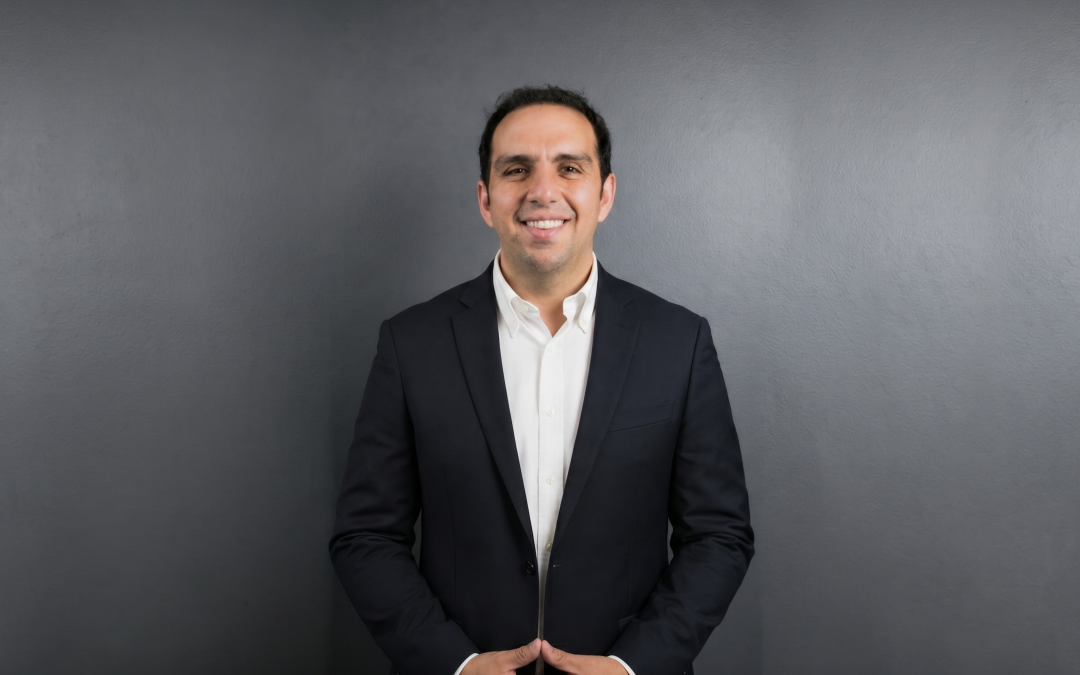
Partner in a legal media outlet, board director, and with a foot in the world of hospitality, Esteban Ruiz brings a vision to JUNTOS where the Law is the engine that allows ideas to scale.
The distance between the legal code and the camera is much shorter than it seems. For lawyer Esteban Ruiz, the Law is actually the invisible architecture that supports every story. If cinema is a leap into the void, his job is to ensure that the parachute is well-designed and the landing is on solid ground.
Across from the JUNTOS office, the team from Estadio Diario—a legal news outlet where Esteban is a partner—is at work. From there, he says, he began observing the production company’s work. “I was struck by the professional approach within an industry that still has a lot of room to grow in terms of standards. I wanted to contribute my experience to a place where talent already exists, but structure and order are lacking.”
In an industry where intellectual property is the most valuable asset, his role transcends the simple act of sorting paperwork. Law is part of the foundation upon which the creative industry is built: protecting an idea, regulating image rights, or negotiating platform contracts is what allows a project to exist and scale up.
Given his professional dynamism, it is no surprise that Esteban decided to venture into the world of film. From his work in a trade association and the challenge of startups to managing a bar or his past as a manager for bands and actresses. “Studying law opened doors for me, but I have always tried not to limit myself to the legal sphere. I like to understand the human dynamics behind every project,” he states.
Recently, during the filming of Que Se Acabe Todo, Esteban was able to witness the JUNTOS team on set for the first time while simultaneously handling his legal duties. “One can imagine it’s a demanding job, but experiencing it is something else. Shooting days have a level of energy, coordination, and pressure that is truly surprising: the number of people, the precision required for every scene,” he reflects. “That, in some way, also impacts how one practices law in this context: it forces you to be more agile, more practical, and more connected to the actual operation, understanding that many legal decisions must be made in dynamic, high-stakes scenarios.”
“What excites me most is the partners’ vision. There is a desire to do things right and a clear conviction to build a production company that is a ‘movie-making machine’ in the best sense: with consistency, quality, and a long-term strategic outlook,” he concludes. At the JUNTOS table, Esteban ensures that while creativity flies high, the legal foundations have the strength to support the production company’s growth.